
Saving British Children for 100 Years
The English writer and preacher Thomas Fuller’s phrase ‘Charity begins at home, but should not end there’ is often abridged to present almost the exact opposite meaning from his original intention.
Save the Children’s story did not begin a hundred years ago in 1926 with British children. The Fund itself had been founded seven years earlier than that, in the immediate politically and emotionally charged aftermath of the First World War. Its first great cause was a spectacularly controversial one: to save German and Austrian children.
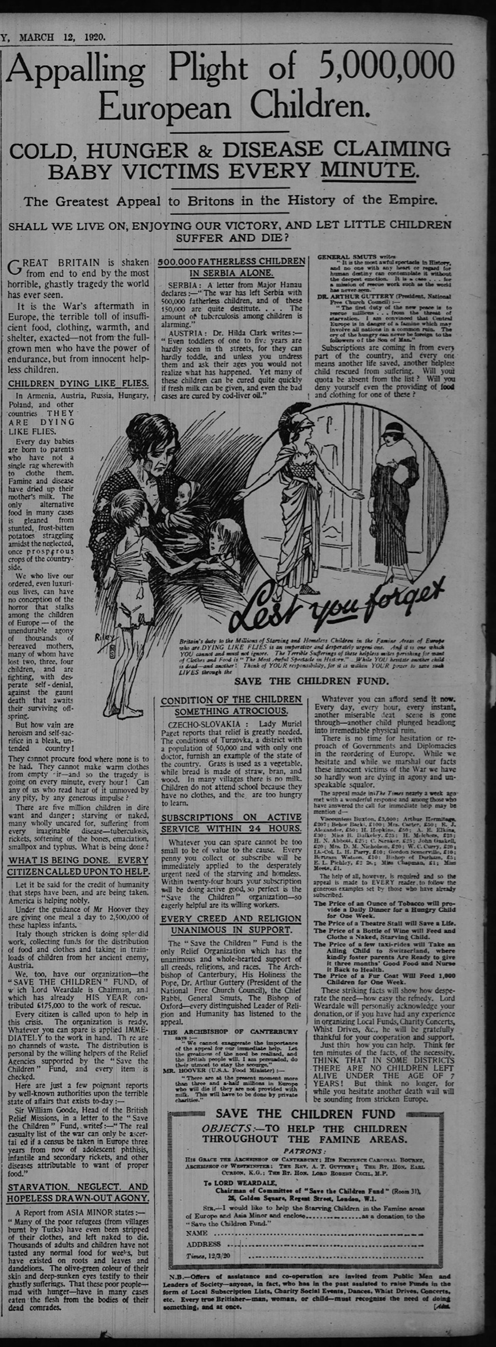
With the Allied blockade continuing after the Armistice until the Treaty of Versailles was concluded, deaths in the German civilian population soared. A British public still reeling from the horrors of the Somme and Ypres were inspired by Save the Children’s founder, Eglantyne Jebb and her sister Dorothy, not to punish the enemy’s children for their parents’ war. Through the Fight the Famine Council and then the newly created Save the Children Fund, she argued that starving a defeated population was neither just nor wise – and that a child in Vienna or Berlin had as much right to food as a child in London or Manchester.
But seven years later, in 1926, the firestorm surrounding Save the Children’s first major UK intervention concerned only a marginally less explosive political minefield.
That year, a hundred years ago, while the Fund was still young, Britain was convulsed by the General Strike and the long miners’ lockout that followed. The country was divided down the middle in a manner that makes the disagreements of today seem almost genteel. Revolution was in the air. In that setting, Save the Children helped to launch its first domestic projects, working in coalfield communities such as South Wales and Cornwall, delivering a scheme to provide free milk to British schoolchildren whose parents’ wages had vanished.
This was targeted aid that saved lives. It did so quietly, through schools, in a way that could be framed as child health rather than subsidy to strikers. Bottles in, bottles out; children drinking their half-pint under a teacher’s eye; milk monitors carrying crates and collecting empties. No possibility to divert the aid to the miners themselves. It was practical, low-key, and politically catastrophic if handled badly.
Save the Children has always been at pains to point out that its actions were not ‘pro-German’ or ‘pro-miners’. They were pro-children, and everything else was political interpretation. Jebb’s own Declaration of the Rights of the Child insisted that children must be helped ‘without distinction of race, nationality or creed’. That principle applied just as much to the children of defeated enemies in 1919 as to miners’ children in 1926.
And so began the quiet, largely unannounced work of Save the Children’s hundred years in the UK. Very quickly, all concerned realised that it was usually best to say as little as possible in public rather than try to explain the complexities of the work. Saving children was too important to risk being trapped on one side of party-political arguments. That role was for others; Save the Children’s job was to keep children alive and help give them a chance, if no-one else would.
Decades later, when I worked for Save the Children in the 1990s, I was surprised to discover that a third of the organisation’s voluntary income – donations from the public – was being spent on UK projects. This wasn’t an accident, it was a plan set out by the Trustees; a reflection of the special needs in the UK at that time, especially as the situation worsened in Northern Ireland in the years leading up to the Good Friday agreement.
That proportion of UK work has risen and fallen many times over the hundred years since 1926 as needs have evolved, but domestic work has been a constant backdrop to the more well-documented international initiatives: miners’ families and nursery schools in the 1920s and 30s, evacuee nurseries and wartime projects, later work with children in care, broken families.
The late Rodney Breen was Save the Children’s first professional archivist; I met him when I worked there, in the pre-internet age. An obsessive factfinder, he spent every spare hour – long evenings and weekends – hunting through boxes of old paperwork for proof of the hints and allegations he found in the official files. One question in particular fascinated him: to what extent were the 1946 free school-milk regulations, introduced under Education Minister Ellen Wilkinson, part-inspired by Save the Children’s miners’ milk initiative in 1926? Was there a direct connection from Save the Children’s first major UK project with the miners’ children to the legislation twenty years later that gave free school milk to a generation of baby-boomers throughout their childhood?
Rodney knew Hansard was quiet on the matter – but, as he liked to point out, of course it would be. The politics of feeding miners’ children in 1926, and the politics of cementing free school milk as part of the post-war welfare state in the 1940s, were never likely to be spelled out quite as bluntly as an archivist might wish. Yet he could see the lines of connection: the same language of child nutrition, the same focus on milk, the same overlapping networks of campaigners and officials. Name after name on both lists.
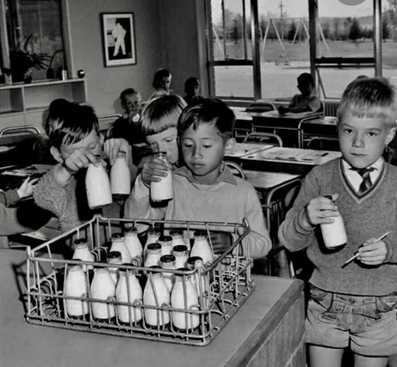
And those milk monitors, counting the aid being delivered, full bottles in, empty bottles out – who can fail to catch an echo in those stock images from later famines of sacks of grain or cartons of high-energy food, being checked off a Save the Children truck against a tally sheet by a village elder? The tools change; the core idea of accountable aid delivery does not.
The policy of quietness – the decision, time and again, to downplay the politics in order to keep the programmes going – has meant that a lot of the detail of this fascinating history has been lost. At best it survives only in fragments and memories; a small price to pay in the biggest picture. The children were fed; they grew; many of them lived long enough to forget that they were ever ‘a case’ at all.
But as 2026 rolls in, it does feel like time to raise a glass to a hundred years of saving British children – and, in the process, German and Austrian children, Biafran and Ethiopian children, Angolan and Rwandan children, Zimbabwean and Cambodian children, children in Bangladesh, Palestine and so many other places. The list is too long. Far, far too long.